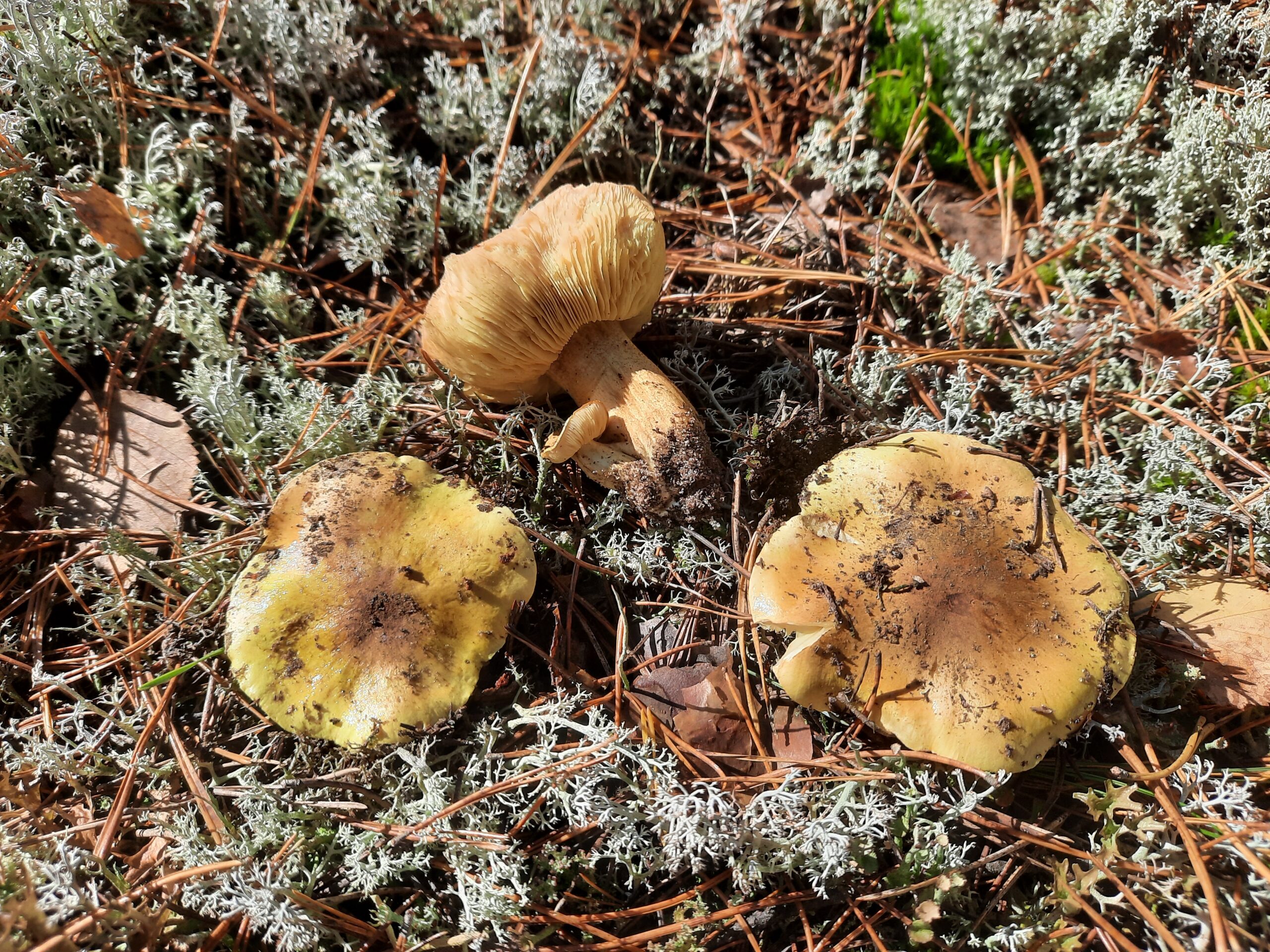
“Zielonki” mushrooms gathered by one of Katra’s elderly residents. Photo by Dalia Blažulionytė. CC BY-NC-ND 4.0.
By Eunice Blavascunas
“I do not find the mushrooms. The mushrooms find me!” And with this declaration 82-year-old Zinaida justifies breaking the rules.1 She enters the forest commons–turned–military-exclusion zone to meet the mushrooms that want to locate her. Lithuania, like its neighbors Latvia and Poland, created special defense zones at their borders with Belarus beginning in 2021, a year before the full-scale war in Ukraine began, and a year after massive protests against Belarus’ Lukashenko regime.2
This border-defense zone prevents most asylum seekers from crossing into the EU, yet has not stopped the flow altogether. The Lithuanian government created the military zone in 2022 for what has been called “hybrid warfare.” At this specific border, as well as at the Polish-Belarusian border and the Latvian-Belarusian border, Putin’s “hybrid warfare” includes the orchestration of refugees into the EU via Lithuania with the intent to destabilize Lithuania and Europe.3

The 200-meter zone begins just south of Zinaida’s house and stretches to the Katra River. Zinaida’s home sits between this military exclusion zone and a strictly protected nature reserve. Čepkēliai, the biggest raised bog in Lithuania, received its protected nature reserve status in 1975 and is now a part of Dzūkija National Park, created in 1991 when Lithuania gained its independence from the Soviet Union. Zinaida’s small home functions as a buffer zone between the nature reserve and the militarized zone, which is also the EU boundary. Previously the border zone of Katra was fluid, open to crossings and exchange when the former Lithuanian and Belarusian Soviet Socialist Republics existed within the Soviet Union. Border guards now keep Zinaida from entering the defense zone. Where is one to pick mushrooms then? Today, it is as if Zinaida and her two neighbors live on a peninsula, with the limited-access nature reserve on one side and the border zone on the other.
Despite the region’s poor soils, mushrooms have sustained forest communities in the Dzūkija region for centuries—as both food and income. In bountiful harvest years residents left their fields untilled, choosing instead to pursue mushrooms. The multiethnic people from this region have been firmly established in not just the consumption but also the sale of mushrooms since at least the seventeenth century when Lithuania was part of Tsarist Russia. These free gifts of the rain and the mossy understory on the nutrient-deficient soil enabled forest dwellers to earn wealth, buy bread, and even build houses. Italians formerly operated purchase points in nearby Marcinkonys beginning in 1912. Purchase points are still found throughout the region today. Where villagers don’t have cars to bring their mushrooms to buyers, buyers with vans route through remote villages, where they quickly sort mushrooms into quality classes and offer cash for baskets of mushrooms.4

Now this historical and economic tradition seems somehow quaint in relation to the threat of Russian aggression or the asylum crisis. In fact, the tradition and the patrols collide. Patrols are meant to protect Lithuanians from any irregular activity at the border, but who lives at the border, and do they feel that they are Lithuanians in need of protection? Journalist Vidmantas Balkunas notes that this is “a village located in Lithuania, but living its whole life in Belarus.”5 Even today, residents speak little to no Lithuanian. The now elderly all sent their children to school in Belarus. They still watch Belarusian television. They once did all their shopping in Belarus, often crossing a small footbridge that connected the two former Soviet Republics. Just a few years ago, it was easy to cross by foot between the two countries. Now, Katra village marks the end of the road. Beyond it lies the bog. A few decades ago, 105 people lived here, Zinaida tells us. Now there are three. Each of them octogenarians and widowers.
The nature reserve, the founding of which limited access to mushrooms and berries, was created much earlier. In 1975 biologists convinced the Soviet Union to add the largest raised bog in Lithuania to its system of Zapovedniki, or strict nature reserves. The rules of the reserves allowed legally residing residents into the bog and surrounding forests for limited berry and mushroom collection only a few weeks out of every year. Zinaida and her two neighbors know the local approaches to navigating the specific restrictions of the Čepkeliai Reserve, the places where one can go without being seen. So Zinaida enters the new border-exclusion zone despite restrictions, defiantly taking what belongs to her in locations she has visited for more than 70 years. Although Zinaida grew up in a village on the Belarusian side of the border, only moving to this Lithuanian village around 1970, her knowledge of this place and its particularities for mushroom harvesting are the result of a lifetime of accumulation.

In the late summer and into fall Zinaida searches daily for slippery jacks, boletes, chanterelles, and the Tricholoma species known regionally as zielonki (the greenish goose). She sets off to her mushrooms repeatedly, against the orders of the border guards, who regularly catch her and escort her back home. While her behavior might appear baldly defiant, it might better be described as an act of resistance, surveillance, and care.
When E. P. Thompson wrote Whigs and Hunters (1975) he laid the groundwork for understanding forests as sites of legal, environmental, and social transformation at the beginning of the eighteenth century in England. His work has been fundamental to political ecology’s critique of nature conservation and green dispossession ever since.6 Whigs and Hunters showed readers the mechanism by which land that was previously shared became privatized, or taken by the state from local users, often without legal ruling. But Thompson’s work never considered the oddities of care when enforcers engage with agents of resistance, nor about how enclosures work when the commons are enclosed for strictly military purposes within the larger protective zone of nature conservation.
Zinaida’s disregard for the scoldings she receives from border guards are matched with an uncanny appreciation of their concern for her. The life of the elderly in such villages can be lonely. Border guards provide regular social encounters, but they and the newly imposed rules about access prevent her from easily maintaining social ties across the border and across her lifespan, ties to her children, to graves, and to locations across generations. Understanding that borders have also crossed people over the course of the last few centuries explains Zinaida’s complicated feelings toward the impositions and opportunities in her life. Over the last two centuries this forest has been under the rule of the Russian Empire, interwar Poland, the Soviet Union, and now independent Lithuania.
“It used to be that Belarus and the land used to be kind and good. Lithuania used to be kind and good, but not now. Now Lithuania has banned kindness.” Zinaida’s voice quivers and breaks and she brings it to a high pitch of indignation. “Alone . . . alone without a car, carrying everything back and forth by foot!” Her lament seizes my sympathy and attention. She is distressed on a level that is concerning, and I cannot understand all the details as Dalia Blazulionyte, my Lithuanian anthropology colleague, translates from Belarusian, a language I am somewhat familiar with given my fluency in Polish and research at the Polish-Belarusian border.

Zinaida is a Belarusian speaker. In fact, she doesn’t use Lithuanian. She explains to me that her parents were Polish, Belarusian, and Russian. Such borderland citizens of mixed identities might identify differently to gain benefits or hide problematic affiliations at different historical moments. Dalia explains that residents of Belarusian villages along the border call Lithuanians “Poles,” as they are both Catholic, confusing matters of identity. Zinaida is Orthodox. Although Poles and Lithuanians previously shared a common heritage under the Polish-Lithuanian Commonwealth of 1569 to 1795, within which, Ruthenian (old Belarusian) was used administratively until the late seventeenth century, they have also violently clashed.7
While soldiers have long patrolled or fought wars with one another over the centuries, this region has a current heightened geopolitical meaning. Given that Belarus is viewed as a vassal state of Putin’s Russia, one that has grown more and more repressive since the breakup of the Soviet Union, Lithuanians fear that the Suwałki Gap separating Russian Kaliningrad from friendly Belarus could be next in line for an invasion should Russia succeed in its war with Ukraine. The border presence and surveillance has intensified since Lithuanian independence, and while there are fewer refugees crossing the border than a few years ago, Putin’s threats and drone incursions make everyone more tense. Border patrol thus restricts Zinaida’s movements.

Zinaida weeps, openly describing her situation. Her husband died four years ago from the COVID-19 epidemic. There is no indoor plumbing in Zinaida’s house. Her outhouse sits at a remove from the main house. We help her draw a few buckets of water from her well. She heats the house entirely with wood, which she must haul from the barn to the house. Most days she is alone. Only when her neighbors are present, and not at their children’s house, is there someone to talk to.
Elderly people who cannot produce anything economically valuable experience additional confinement through the closure of the commons. The military exclusion zone, technically speaking, corners Zinaida into a smaller area from which to harvest, away from the mushrooms she most desires. The places where her mushrooms grow connect her across borders and to her children. Her son and daughter, only 80 km away but in Grodno, Belarus, anticipate that she will bring dried rings of bolete mushrooms and jars of preserved mushrooms on her winter residencies there. Travel between the two countries can sometimes take days of waiting in car lineups, especially in the direction of Belarus toward Lithuania.
Zinaida’s children cannot easily come to her, as Belarusians do not always get through to Lithuania. It’s a bit easier in the other direction, but Lithuanians rarely go to Belarus. Zinaida is one of them, but she has no way of reaching her children unless they retrieve her. Thus, “Lithuania banning kindness” is a remark made in the context of a border that is increasingly closed, a forest that one cannot enter to supply mushrooms for those social ties, and a lack of basic services.

Paradoxically, just as border patrol has confined her to a smaller harvest zone and made travel to Grodno more difficult, in other ways the world she could not have anticipated has arrived. She is positioned in the midst of global movements of desperate people, and of wars both near and far that create human movement through exquisite and often protected forest zones to reach the EU. Like other residents, she finds Arabic-script candy wrappers littered on the moss and sees border patrol chasing Black and Brown bodies down her street. “Those Black people walked here first. [The border guards] used to catch them. Ten people came to me. So, maybe the border guard is good that they don’t let me go mushroom picking?” she wonders. What had been a seldom-visited corner of the forest, one of the best-known forests in all of Lithuania to harvest mushrooms, is now a place of regular patrols. Surveillance cameras watch people who might think they are alone in the woods, including humanitarian volunteers and elderly mushroom pickers. Zinaida refers to the asylum seekers as “bandits” and helps us understand that she also thanks the border patrol for protecting her home from them.

This combination of forces pressing in on Zinaida and the commons collide to bring out what Ewa Majewska has called “weak resistance,” an elaboration and variation of James Scott’s “weapons of the weak.” Both scholars elucidate that the marginalized might use their agency to obfuscate or stymie the processes that are dispossessing them of their rights to usufruct, to derive profit from property of which they lack ownership.8 Like the protagonists of James Scott’s Weapons of the Weak, Zinaida is both trying to preserve symbolic face as what is rightfully hers is taken from her while also challenging the moral order of a new agrarian organization, one triggered first by the fall of the Soviet Union and its subsequent increase in nature preserves through the 1990s in eastern Europe.9 The existence of the Čepkeliai Reserve (11,212 hectares), within the larger Dzūkija National Park (584 square kilometers) is part and parcel of the forces that have made Zinaida and her life, in fact the village of Katra, obsolete. She and Katra are too far removed to benefit from tourism to the region. Understood within Majewska’s concept of “weak resistance,” Zinaida’s ethics are precarious, her agency not heroic. She emerges here as a subject of importance, trying to survive, not win, and therefore she is ambiguous within the bigger history of enclosures that E. P. Thompson first brought attention to. And now enclosures are due to border patrol, not just nature reserves. “Weak does not mean impossible,” Majewska writes, “it means resisting.” And what Zinaida is resisting for is the right to enter the forest to harvest her mushrooms.

Zinaida’s narration moves along what seem like chromatic scales, from tears to gratitude to indignity. “You go to the road to pick up mushrooms, and they stop and ask ‘What are you doing here, grandmother?’ They want me to move along. I tell them, ‘I am a woman past 80 years of life, and how is it for you [border guards], so young . . . How does your tongue even lift to hustle me along?’ How is it they can talk to me like that and then give me a ride [back home]! Why don’t they just let me through then [to pick mushrooms] if they’re going to give me a ride back home?”
But there are moments when Zinaida finds a way to reflect and consider what it is that the border patrol might give her. “I’m not talking crap, I won’t say that Lithuania doesn’t care about us Belarusians. The border guards give me a lift. I go out onto the road [bordering the exclusion zone] to pick mushrooms, and they stop and ask, ‘Babushka, what are you doing here?’ They want me to move along,” but then, she adds thoughtfully, recognizing her own frailty and the situation, “they give me a ride back home with my mushrooms . . .”
Like the asylum seekers who attempt to cross to the EU, border guards are also pushing Zinaida back. “Turn around” is the term the Lithuanians use instead of “pushback” to refer to the ways they send asylum seekers back to Belarus. But of course, with Zinaida, this “turn around” is less violent and displays more concern for her welfare. My Lithuanian colleague Dalia reassures Zinaida, “the border control are thinking about your well-being and that’s why they won’t let you go through.” Zinaida explains, “I go to the bushes and there are those guys [border patrol] who chase me out . . . they keep chasing me . . . I can be going to the bathroom and they dare to chase me away!” In this narration I can see that Zinaida is actively thinking about how to present border patrol to us. She is angry at the guards. But she also realizes she might need them. “It’s good for us that they drive in the villages. There are no bandits here because they keep driving back and forth.” E. P. Thompson never touched upon the unexpected encounters that occur during enclosures, the moment when the imperfect subjects identify their vulnerability in the context of care.
These moments of vulnerability, relief at getting a ride, assertions of superiority and dignity, given her age and long-term dwelling, exemplify care and resistance in the enclosures of the commons. Care can bring up ethical ambiguities. Border guards are there to prevent both asylum seekers and Russian soldiers, or supposed “foot soldiers” of Russia (frequently perceived as refugees) from getting through. They also don’t easily let Belarusians enter Lithuanian territory, for fear that they also might be a destabilizing force, despite the large diasporic Belarusian community within Lithuania. This brings to mind Tom Van Dooren’s work on the violence of care within conservation regimes, which might help us reflect upon this case where there is a slippage between nature reserves and military exclusion zones.
When Van Dooren refers to care, he means the affective domain of critical emotional labor which upon examination unearths complicated obligations. Per Van Dooren, our responsibility to care calls us to reimagine the values and problematics of care when some beings need to be killed in order for others to receive benevolence and consideration. “As an ethical obligation, to care is to become subject to another, to recognize an obligation to look after another.”10 And I can’t help thinking about how this applies to the calculations of border guards as they both “catch” Zinaida and unofficially and casually check on her well-being, while at the same time enacting violence upon asylum seekers, a matter documented extensively by humanitarian groups.11 Border protection and wetlands protection are not antithetical. Nor are surveillance and concern for well-being. Together, they frame the work being done for the good of Lithuanian citizens, some of whom benefit much more from enclosures than others, as those enclosures are both for nature protection and for border defense.

Educated and urban Lithuanians seek out some of the most traditional of Lithuanian lands in the Dzūkija forest, as they buy up property an hour’s drive north of Katra. Many villages in eastern Europe have faced degradation and devaluation over the last 35 years since the Soviet Union collapsed. This is especially true for those placed on the wrong side of nature reserves, and perhaps the wrong side of the border, which is Zinaida’s dilemma. Enclosures both create sites of resistance by commoners, and serve as sites of accumulation by the wealthy. In the case of this Lithuania borderland, a younger generation seeks to root themselves in authentic Lithuanian heritage just north of the Čepkaliai Reserve. There, Lithuanian tech workers buy and refinish homes for young families as they commute between Switzerland or Norway for higher paying work. This is the agrarian reform of the last 35 years, one situated in the geopolitics of an ascendant and aggressive Russia.
The contrasts between new money and impoverished elderly are palpable in the Lithuanian countryside, meaning that Zinaida is operating in a world where she is pressed to demonstrate her value to those she encounters, which I can see in her narration about border guards.
She wants to move in the opposite direction of asylum seekers, to Belarus, and to do so while expressing gratitude and indignation toward a Lithuanian state that sees everyone moving from the direction of Belarus as a potential threat. “I called my children today to say that maybe I should just come over the river illegally, climb through the bushes, but the border patrol keeps driving back and forth. But when I’m there [in Grodno], they [border patrol] watch my house . . .” She again changes her mind about border patrol’s value to her, “but they are stopping me from getting zielonki!”
Zinaida must invent methods to divert attention, gather mushrooms, and eventually bring those mushrooms to Grodno.
“So, I’ll use my walking stick,” she further strategizes, “to cross [to the militarized zone] and get those zielonki. I’ll ditch the cart and sneak out and pick them, using just the stick for support. The border guards would otherwise follow the tracks of my cart.”
Labor and life shape landscapes and when the state seizes vernacular landscapes, whether for nature preserves or border defense, the only way out is to continue strategizing within one’s capacity.
“I was climbing to where the mushrooms are. Of course, I see [the border guards] coming and need to avoid them. It’s worked before. I drop to the forest floor. They don’t see me. And when they’ve passed, I go sideways down the road and through the bushes . . . but,” she pauses and reflects on dreary but probable scenarios altering her previously animated assertation that would make you think she was a nimble escape artist instead of someone who ambulates slowly with a large walking stick, “but if I died in the forest, the border guards would have to care. They would have to care if I died in the bushes!” She ruefully recognizes her vulnerability as she speaks.

The care that could be offered to her, should she die in the bushes, contrasts with accounts of refugees dying as they cross the border through the forest.12 Zinaida, in this weird calculus, has gained visibility. She counts as a Lithuanian citizen, and is seen as a person in need of care. Having reconstituted her value in this way, a terrifying prospect, she shows her agency on the stage of history and has claimed new territory in the process.
When border guards do catch Zinaida, she explains to them that these mushroom patches are hers. And sometimes the border guards even compliment her on the amount of mushrooms she finds. “They are in awe at how! But they say to me ‘Babushka, you weren’t going that way, were you?!,” referring to the exclusion zone, “and I tell them . . . ‘no, the mushrooms found me.’”
Relishing in her sly victory with us, clearly visible in the abundant harvest behind her on the porch, she says, “I tell them, I killed myself real good!” Holding a well-formed firm king bolete to her mouth, she pronounces, “at least a hundred!”
Author’s Note
I am deeply grateful to Dalia Blažulionytė who brought me to Katra and introduced me to the people and ideas in this article. I would also like to thank Nastasya Kosygina for help with translations of the taped interview. This article was written while at the Landhaus, the Rachel Carson Center’s abode for writers in the environmental humanities.
- Interview with Katra resident conducted in confidentiality, June 2024. ↩︎
- Alexander Lukashenko has ruled Belarus since 1994. Now in his eighth consecutive presidential term, the regime has long suppressed political dissent. Major public opposition to the regime arose after a contested election in 2020, where hundreds of thousands of protesters spilled into the streets and were met with state violence and imprisonment. Much of the opposition is now in exile in Lithuania, Poland, and other European countries. ↩︎
- The Belarusian regime has been luring desperate asylum seekers and migrants from the Middle East and Africa to Belarus before transporting them close to the border in the vast forest complex, running along Poland, Lithuania, and Latvia. The roots of Lithuania’s militarized border go back to 2021, following the momentous 2020 protests in Belarus and Lukashenko’s subsequent crackdown on the opposition movement. As the EU imposed more sanctions on Belarus, Belarus and Russia actively trafficked migrants from Syria, Afghanistan, Yemen, Iraq, and other Middle Eastern and African countries to destabilize Europe. Belarusian border guards often aid asylum seekers in reaching the other side, leading to the construction of a border wall in 2022. Many forests with “high natural values” along this border have seen increased patrols. (“High natural values” is a way that nature conservationists describe land that may or not be in a protective reserve, but has some kind of ecological integrity and is not highly degraded.) For more information, see: Jordi Bakker, “Weaponizing migration and reinforcing border protection: Development of Belarus-Lithuania border dynamics between the 2020 Belarusian presidential election and the start of the 2022 Russian invasion of Ukraine,” Center for Border Studies 16 (2022): UniGR-CBS Working Paper Vol. 16.pdf. ↩︎
- Dalia Blažulionytė, “Grybų pardavimo verslo tradicija šilinių dzūkų krašte,” Dainava 2, no. 4 (2020): 27–34. ↩︎
- Vidmantas Balkunas, “Gyvenimas ant rubežiaus: Katra—Lietuvoje atsidūręs Baltarusijos kaimas,” Delfi, 26 December 2020, https://www.delfi.lt/news/daily/lithuania/gyvenimas-ant-rubeziaus-katra-lietuvoje-atsidures-baltarusijos-kaimas-85867671. ↩︎
- E. P. Thompson, Whigs and Hunters: The Origin of the Black Act (Allen Lane, 1975). ↩︎
- Curt Woolhiser, “Constructing National Identities in the Polish-Belarusian Borderlands,” Ab Imperio no. 1 (2003): 293–346, https://dx.doi.org/10.1353/imp.2003.0022; Tomas Balkelis, “The Polish-Lithuanian Conflict: ‘A Dirty War,’” in War, Revolution, and Nation-Making in Lithuania, 1914-1923, The Greater War, ed. Robert Gerwarth (Oxford University Press, 2018). ↩︎
- Ewa Majewska, Feminist Antifascism: Counterpublics of the Common (Verso, 2021), 15. ↩︎
- James Scott, Weapons of the Weak: Everyday Forms of Peasant Resistance (Yale University Press, 1985). ↩︎
- Thom Van Dooren, “Care,” Living Lexicon for the Environmental Humanities, Environmental Humanities, vol. 5 (2014): 291. ↩︎
- Alicja Palęcka, State Violence and Grassroots Activities: The Ocalenie Foundation’s Report on the Humanitarian Crisis in the Polish-Belarusian Border Region (Fundacja Ocalenie, 2022). ↩︎
- Enira Bronitskaya, Alena Chekhovich, Aušrinė Gogelytė, Anna E. Griķe, Dalia Krapavickaitė, Alicja Palęcka, and Ieva Raubiško, No Safe Passage: Migrants’ Deaths at the European Union-Belarusian Border, ed. Alicja Palęcka (Fundacja Ocalenie, 2024), https://ocalenie.org.pl/wp-content/uploads/2025/03/eng_no-safe-passage.-migrants-deaths-at-the-european-union-belarusian-border-1.pdf. ↩︎
““How Does Your Tongue Even Lift to Hustle Me Along!”: Care and Surveillance in the Lithuanian Borderland” © 2026 by Eunice Blavascunas is licensed CC BY-ND 4.0.
