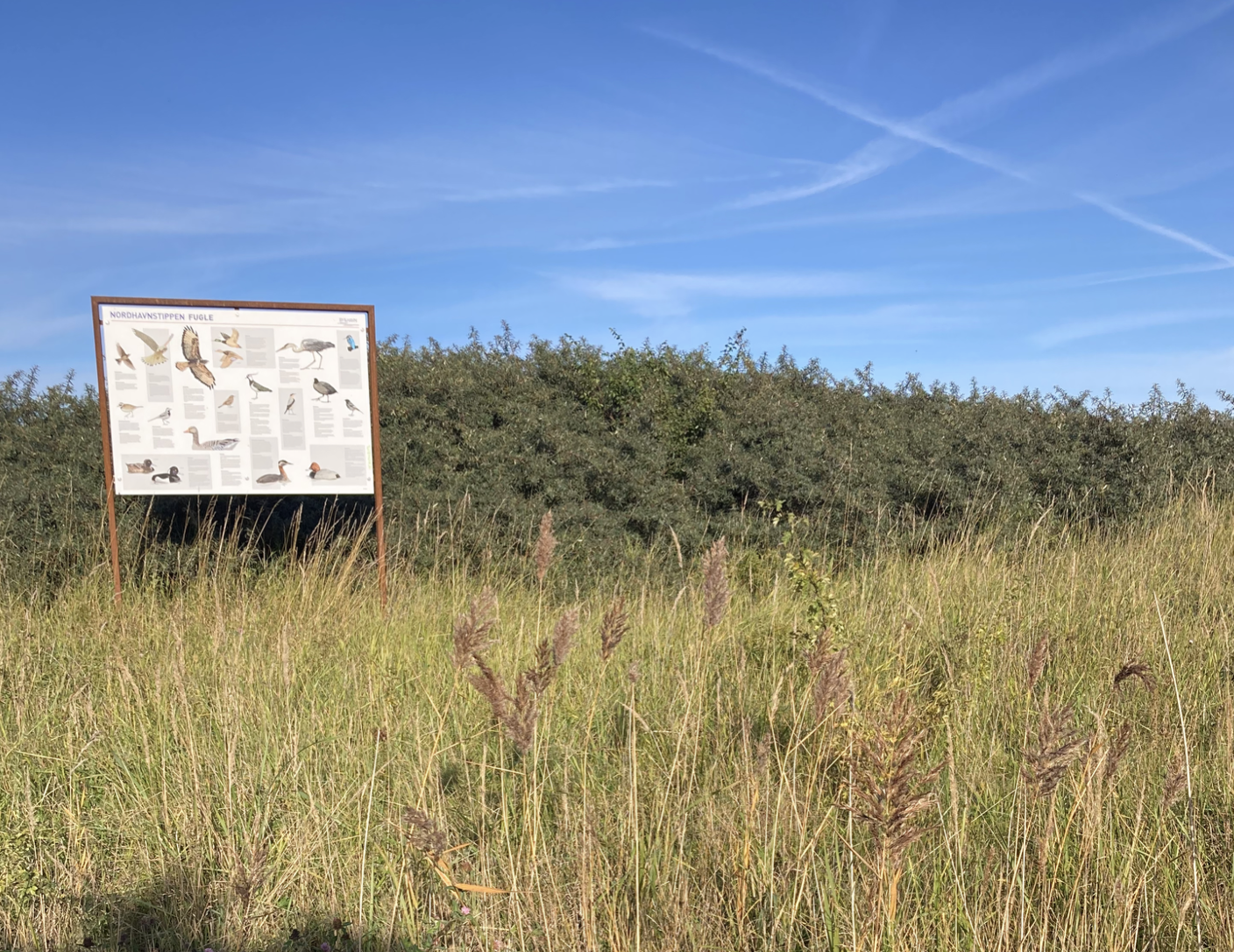
Nordhavnstippen, a space for birds and ruderal nature, 2024. © Natalia Rodriguez-Castañeda. All rights reserved.
by Natalia Rodriguez-Castañeda
What do Los Cerros, Bogotá’s degraded peri-urban forested mountains, and Nordhavnstippen, Copenhagen’s abandoned post-industrial site with emerging ruderal vegetation, have in common? The two sites highlight the opportunities and challenges of embracing novel, ruderal, and spontaneous forms of urban nature—urban novel ecosystems—through the lens of global health approaches such as one health1 and planetary health.2
Novel ecosystems3 in cities manifest in different forms, ranging from wildflowers, shrubs, and tall grasses that grow spontaneously to poorly-managed or minimally-intervened urban ecosystems where natural rather than anthropogenic forces shape the character of the landscapes.4 These emergent and ruderal forms of nature are often found in post-industrial landscapes (such as Nordhavnstippen in Copenhagen) or in sites undergoing participatory ecological restoration processes where assemblages of native and non-native species co-exist and co-inhabit (like in Los Cerros in Bogotá). Such spaces are gaining recognition in the academic and practical fields of urban planning, policy-making, and urban ecology.5 This recognition is associated with the sites’ potential to protect and promote biodiversity and to be resilient urban ecosystems, while also providing spaces for people to connect with nature.6
The increasing interest of urban planners in urban novel ecosystems is particularly important, as these landscapes are often overlooked or undervalued due to their perceived aesthetic “messiness” and their contrast with conventional notions of urban greening that emphasise manicured parks or ornamental gardens.7 Yet on a rapidly changing, anthropocentric, and increasingly urbanised planet, urban novel ecosystems may offer valuable opportunities to rethink human–nature–health relationships in cities, while also enabling connections with nature, promoting biodiversity, and facilitating ecological knowledge exchange.8 Meanwhile, global health approaches such as one health and planetary health contribute to further exploring the value of these ecosystems across local to planetary scales, considering human–environment–animal–biodiversity well-being in the context of rapid global environmental challenges like climate change.9
One health is an interdisciplinary and transdisciplinary global health approach that was initially applied in veterinary, medical, and environmental sciences to research zoonotic and infectious diseases at the interface of human, animal, and environmental health.10 Its research applications have contributed to identifying potential risks and benefits from human–animal contact, promoting solutions and collaborative approaches to public health issues at local, regional, and national scales. Similarly, as the relevance of this interfaced approach gains attention, the discussions of this framework have included the topic of health from a socio-ecological-health perspective, including human mental-health issues and the role of urban green spaces.11 Complementary to this approach, the concept of planetary health emerged from the Lancet Commission in 2015.12 Planetary health acknowledges the importance of addressing the health challenges of the Anthropocene and emphasises the interdependencies between environmental and human well-being.13 This approach examines how human-driven environmental changes at global and planetary scales, such as climate change and urbanisation, impact both natural systems and human health.14
Combining these two approaches into a framework that addresses one-planetary-health can help us to better understand and promote health and well-being in cities. It enables us to rethink urban ecosystems in a way that extends beyond human well-being to encompass the health of ecosystems and their biological diversity on a dynamic, changing planet.15 Within this perspective, urban novel ecosystems such as Los Cerros and Nordhavnstippen can be seen as sites where local community engagement and biodiversity-conservation efforts contribute to addressing both local and planetary environmental challenges related to climate change, rapid urbanisation, and environmental degradation.

In Bogotá, Los Cerros is a peri-urban and mountainous ecosystem that has both shaped and withstood the city’s growth and development. Due to its proximity to the urban area, its elevated landscapes are visible from almost every point in the city, and have become an implicit and explicit part of the lives of people in Bogotá. The Los Cerros ecosystem has been degraded for decades due to the misuse of natural resources including the removal of clay soil for brick production, the extraction of forest wood for charcoal, rapid urbanisation, and misguided reforestation efforts that introduced non-native species.16 These different anthropogenic pressures have severely impacted this vital ecosystem that serves as a connective corridor between the city’s urban green spaces and the surrounding rural and endemic ecosystems.17 Consequently the area has become increasingly vulnerable to climate change, wildfires, biodiversity loss, and broader ecological degradation. In the last decade, however, local community initiatives have promoted participatory ecological restoration to recover the functionality of the ecosystem.
Amid this complex socio-ecological context, with environmental challenges threatening the health of species and ecosystems, local communities around Los Cerros have become increasingly aware of the importance of ecological restoration. In this scenario, Los Cerros, through participatory ecological initiatives, has become an urban living lab where local community groups, academics, government stakeholders, and volunteers collaborate to protect and restore the ecosystem. Through this initiative, Los Cerros represents a space for exchanging ecological knowledge, planting native species, removing non-native species (such as eucalyptus), and restoring the soil to support the growth of native species and the regeneration of degraded areas.18These local community efforts adopt a more interrelated perspective on health, recognizing that both local and planetary environmental changes impact the health of people and biodiversity. In this context, participation in ecological restoration initiatives offers opportunities to enhance ecosystem health while generating co-benefits, such as raising awareness about the importance of these ecosystems, learning from the species that inhabit and coexist within them, and fostering connections with nature in peri-urban areas. In other words, Los Cerros illustrates how community-driven approaches can help redefine health and empower human agency in times of ecological crisis.19
Los Cerros—as an urban novel ecosystem viewed through a one-planetary-health approach—thereby offers insights into how we can consider health from a more integrated perspective that brings together social, environmental, and health dimensions. This approach invites us to recognize well-being within the reality of a rapidly changing earth system, where local efforts play a crucial role in addressing planetary challenges such as climate change.20 In this light, notions of care and coexistence become essential for the protection, restoration, and integration of these urban ecosystems into the life and resilience of the city.

In Copenhagen, Nordhavnstippen presents another example that invites reflection on how urban novel ecosystems and the communities around them can be integrated from a one-planetary-health perspective. Nordhavnstippen is an eight-hectare protected ecosystem where ruderal and spontaneous vegetation grows on what was once a post-industrial landscape in the rapidly urbanizing district of Nordhavn.21 This ecosystem was recently protected by the municipality of Copenhagen, following efforts by local communities who highlighted the importance of the space for biodiversity, particularly for migratory and endemic birds, and the need to preserve and integrate novel ecologies in an urban district planned to become one of the most sustainable and densely built areas of the city.22
Nordhavnstippen presents one model of how to value these novel forms of nature, how to integrate diverse community voices, and how to ensure the health of people, biodiversity, and urban ecosystems within rapidly changing environments that are vulnerable to rapid urbanization and planetary ecological pressures.23 This ruderal, unplanned, and spontaneous landscape illustrates a broader need to consider cities both for people and for biodiversity, and to integrate and protect such spaces in order to reimagine urban green areas and urban development. Valuing these ecosystems as spaces for contact with nature makes them valuable for fostering nature-based recreational activities, such as foraging, birdwatching, or simply immersing oneself in the natural surroundings.24 At the same time, they serve as important sites for ecological resilience and biodiversity conservation in the face of rapid urbanization and the sustainable development goals that guide planning in Copenhagen.25
Los Cerros and Nordhavnstippen offer real-world case studies that invite us to rethink urban novel ecosystems through a one-planetary-health approach—one that interconnects people, biodiversity, and emerging urban ecologies.26 These sites provide opportunities to position health and well-being within both local and global contexts by valuing community-led efforts that respond to planetary health challenges such as rapid urbanization, environmental degradation, and vulnerability to climate change.27 Identifying pathways to integrate these kinds of ecosystems into urban planning and governance can help address one health and planetary health concerns at the local level. Finally, as reflected in the case studies presented here, this approach emphasizes the importance of engaging and collaborating with diverse stakeholders to reimagine these spaces as opportunities for meaningful connection with urban nature through participatory restoration and conservation efforts. A one-planetary-health approach calls for a greater acknowledgment of our shared ecologies, reinforcing not only the understanding that human health and well-being are inseparable from the health of ecosystems, but also that local actions may have planetary-scale impacts.
Author’s Note
This reflective piece draws upon my PhD research, “Embracing Wild, Restoring Minds: A One Health Approach to Urban Wild Spaces, Mental Health, and Well-being in Sustainable Cities” within the NovelEco project, conducted at the School of Natural Sciences, Trinity College Dublin, in collaboration with the Faculty of Landscape and Urban Planning, University of Copenhagen.
- “One Health,” World Health Organization, https://www.who.int/health-topics/one-health#tab=tab_1.
↩︎ - Kathryn H. Jacobsen, Caryl E. Waggett, Pamela Berenbaum, Brett R. Bayles, Gail L. Carlson, René English, Carlos A. Faerron Guzmán, et al., “Planetary Health Learning Objectives: Foundational Knowledge for Global Health Education in an Era of Climate Change,” The Lancet: Planetary Health 8, no. 9 (2024): e706–13. https://doi.org/10.1016/S2542-5196(24)00167-0. ↩︎
- Richard J. Hobbs, Eric Higgs, and James A. Harris, “Novel Ecosystems: Implications for Conservation and Restoration,” Trends in Ecology & Evolution 24, no. 11 (2009): 599–605. https://doi.org/10.1016/j.tree.2009.05.012; Marcus J. Collier, “Novel Ecosystems and the Emergence of Cultural Ecosystem Services,” Ecosystem Services 9 (2014): 166–69. https://doi.org/10.1016/j.ecoser.2014.06.002. ↩︎
- Christoph Rupprecht, “Informal Urban Green Space: Residents’ Perception, Use, and Management Preferences across Four Major Japanese Shrinking Cities,” Land (Basel) 6, no. 3 (2017): 59. https://doi.org/10.3390/land6030059; Bettina Stoetzer, “Ruderal Ecologies: Rethinking Nature, Migration, and the Urban Landscape in Berlin,” Cultural Anthropology 33, no. 2 (2018): 295–323. https://doi.org/10.14506/ca33.2.09; Natalia Rodriguez-Castaneda, Melissa Pineda-Pinto, Natalie M. Gulsrud, Megan Lynn Maurer, and Marcus Collier, “Let It Grow Wild! A More-than-One-Health Perspective for Wild Spaces in Cities,” Cities & Health (2025): 1–22. https://doi.org/10.1080/23748834.2025.2520112. ↩︎
- Melissa Pineda-Pinto, Christopher Kennedy, Fiona Nulty, and Marcus Collier, “Leverage Points for Improving Urban Biodiversity Conservation in the Anthropocene: A Novel Ecosystem Lens for Social-Ecological Transformation,” Environmental Science & Policy 162 (2024):103926. https://doi.org/10.1016/j.envsci.2024.103926. ↩︎
- Melissa Pineda-Pinto, Marcus Collier, Clair Cooper, Mairéad O’Donnell, Fiona Nulty, and Natalia Rodriguez-Castañeda, “Exploring Urban Novel Ecosystems: Understandings, Insights and Recommendations for Future Research and Practice,” Futures: The Journal of Policy, Planning and Futures Studies 164 (2024):103487. https://doi.org/10.1016/j.futures.2024.103487; Natalia Rodriguez-Castañeda, Melissa Pineda-Pinto, Natalie M. Gulsrud, Clair Cooper, Mairéad O’Donnell, and Marcus Collier, “Exploring the Restorative Capacity of Urban Green Spaces and Their Biodiversity through an Adapted One Health Approach: A Scoping Review,” Urban Forestry & Urban Greening 100 (2024):128489. https://doi.org/10.1016/j.ufug.2024.128489. ↩︎
- Anna Jorgensen and Marian Tylecote, “Ambivalent Landscapes: Wilderness in the Urban Interstices,” Landscape Research 32, no. 4 (2007): 443–62. https://doi.org/10.1080/01426390701449802; Flurina M. Wartmann and Jamie Lorimer, “Messy Natures: The Political Aesthetics of Nature Recovery,” People and Nature 6, no. 6 (2024): 2564–76. https://doi.org/10.1002/pan3.10743. ↩︎
- Rodriguez-Castañeda et al., “Let it grow wild!” ↩︎
- Rodriguez-Castañeda et al., “Let it grow wild!”; Andrea S. Winkler, Christina Marie Brux, Hélène Carabin, Carlos G. das Neves, Barbara Häsler, Jakob Zinsstag, Eric Maurice Fèvre, et al., “The Lancet One Health Commission: Harnessing Our Interconnectedness for Equitable, Sustainable, and Healthy Socioecological Systems,” The Lancet 406, no. 10502 (2025): 501–70. https://doi.org/10.1016/S0140-6736(25)00627-0. ↩︎
- “One Health,” World Health Organization; K. Queenan, J. Garnier, L. R. Nielsen, S. Buttigieg, D. de Meneghi, M. Holmberg, J. Zinsstag, S. Rüegg, B. Häsler, and R. Kock, “Roadmap to a One Health Agenda 2030,” CABI Reviews: Perspectives in Agriculture, Veterinary Science, Nutrition and Natural Resources 12 (2017): 1–17. https://doi.org/10.1079/PAVSNNR201712014. ↩︎
- Rodriguez-Castañeda et al., “Exploring the Restorative Capacity of Urban Green Spaces and Their Biodiversity through an Adapted One Health Approach.” ↩︎
- Sarah Whitmee, Andy Haines, Chris Beyrer, Frederick Boltz, Anthony G. Capon, Braulio Ferreira de Souza Dias, Alex Ezeh, et al., “Safeguarding Human Health in the Anthropocene Epoch: Report of The Rockefeller Foundation–Lancet Commission on Planetary Health,” The Lancet 386, no. 10007 (2015): 1973–2028. https://doi.org/10.1016/S0140-6736(15)60901-1. ↩︎
- Francisco Olea-Popelka, Nicole Redvers, and Saverio Stranges, “Public Health, One Health, and Planetary Health: What Is Next?” European Journal of Public Health 35, no 1 (2025): 3–4. https://doi.org/10.1093/eurpub/ckae149. ↩︎
- Rafael Ruiz de Castañeda, Jennifer Villers, Carlos A. Faerron Guzmán, Turan Eslanloo, Nicole de Paula, Catherine Machalaba, Jakob Zinsstag, Jürg Utzinger, Antoine Flahault, and Isabelle Bolon, “One Health and Planetary Health Research: Leveraging Differences to Grow Together,” The Lancet Planetary Health 7, no. 2 (2023): e109–111. https://doi.org/10.1016/S2542-5196(23)00002-5. ↩︎
- Jakub Kronenberg, Erik Andersson, Thomas Elmqvist, Edyta Łaszkiewicz, Jin Xue, and Yaryna Khmara, “Cities, Planetary Boundaries, and Degrowth,” The Lancet Planetary Health 8, no. 4 (2024): e234–41. https://doi.org/10.1016/S2542-5196(24)00025-1. ↩︎
- Carlos Andrés Meza, “Urbanización, conservación y ruralidad en los cerros Orientales de Bogotá,” Revista colombiana de antropología 44, no. 2 (2008): 439–80. https://doi.org/10.22380/2539472X.1064; Francisco J. Escobedo, Nicola Clerici, Christina L. Staudhammer, and Germán Tovar Corzo, “Socio-Ecological Dynamics and Inequality in Bogotá, Colombia’s Public Urban Forests and Their Ecosystem Services,” Urban Forestry & Urban Greening 14, no. 4 (2015): 1040–53. https://doi.org/10.1016/j.ufug.2015.09.011. ↩︎
- Fabio Alberto Garzón Díaz, “Educación Ambiental y Desarrollo Sostenible: El Caso de los Cerros Orientales de Bogotá, Colombia,” Revista Latinoamericana de Bioética 14, no. 1 (2014): 82-97. https://doi.org/10.18359/rlbi.498. ↩︎
- Laura Catalina Ossa-Carrasquilla, Mauricio Andrés Correa-Ochoa, and Luisa María Múnera-Porras, “La paca biodigestora como estrategia de tratamiento de residuos orgánicos: una revisión bibliográfica,” Producción + Limpia 15, no. 2 (2020): 71–91. https://doi.org/10.22507/pml.v15n2a4. ↩︎
- Natalia Rodriguez-Castaneda, “Contemplating Los Cerros in Bogotá from the nature reserve El Umbral Cultural Horizontes: A therapeutic landscape experience,” NovelEco (September 8, 2023), https://noveleco.eu/contemplating-los-cerros-in-bogota-from-the-nature-reserve-el-umbral-cultural-horizontes-a-therapeutic-landscape-experience/. ↩︎
- Arpit Mago, Arkadeep Dhali, Harendra Kumar, Rick Maity, and Bharat Kumar, “Planetary Health and Its Relevance in the Modern Era: A Topical Review,” SAGE Open Medicine 12 (2024). https://doi.org/10.1177/20503121241254231. ↩︎
- Csilla Duray, Natalie Marie Gulsrud, Natalia Rodríguez-Castañeda, Andrea Šupová, Theresa Trüper, Megan Lynn Maurer, Sofie Burgos-Thorsen, Meaningful Natures in Nordhavn: Baseline Report Exploring Perceptions of Meaningful Natures in Nordhavn (Copenhagen: University of Copenhagen, 2025), https://pure.itu.dk/ws/portalfiles/portal/109741251/0a58c692-7534-406f-8bd4-af8a85d1f582.pdf. ↩︎
- “Nordhavn Naturpark,” Danmarks Naturfredningsforening København, accessed December 6, 2025, https://koebenhavn.dn.dk/vigtige-sager/nordhavn-naturpark; Annaliina Niitamo, “Planning in No One’s Backyard: Municipal Planners’ Discourses of Participation in Brownfield Projects in Helsinki, Amsterdam and Copenhagen,” European Planning Studies 29, no. 5 (2020): 844–61. https://doi.org/10.1080/09654313.2020.1792842. ↩︎
- Duray et al., Meaningful Natures in Nordhavn; Natalia Rodriguez-Castañeda, “Reflections towards a multispecies ethnography perspective in Nordhavnstippen, Copenhagen, Denmark,” NovelEco (September 16, 2024), https://noveleco.eu/reflections-towards-a-multispecies-ethnography-perspective-in-nordhavnstippen-copenhagen-denmark/. ↩︎
- Rodriguez-Castañeda, “Reflections towards a multispecies ethnography perspective in Nordhavnstippen.” ↩︎
- The City of Copenhagen Department of Finance, The Capital of Sustainable Development: The City of Copenhagen’s Action Plan for the Sustainable Development Goals (Copenhagen, 2022). https://international.kk.dk/sites/default/files/2022-01/Verdensmål_UK_WEB_FIN.pdf. ↩︎
- Rodriguez-Castañeda et al., “Let it grow wild!” ↩︎
- Courtney McNamara and Clare Bambra, “The Global Polycrisis and Health Inequalities,” International Journal of Social Determinants of Health and Health Services 55, no. 3 (2025): 238–48. https://doi.org/10.1177/27551938251317472. ↩︎
Planetary health has so far been predominantly studied by natural scientists and medical experts. Over the next few months we will publish a series of essays that illuminate different aspects of the planetary-health concept from a decidedly environmental-humanities perspective. The entries have their origin in the contributions of international scholars who attended the Rachel Carson Center workshop “Imagining Planetary Health, Well-Being, and Habitability,” convened by Lijuan Klassen and Christof Mauch and sponsored by the Volkswagen Foundation.
“One-Planetary-Health: Reflections on Urban Novel Ecosystems in Bogotá and Copenhagen” © 2025 by Natalia Rodriguez-Castañeda is licensed under CC BY-ND 4.0.
