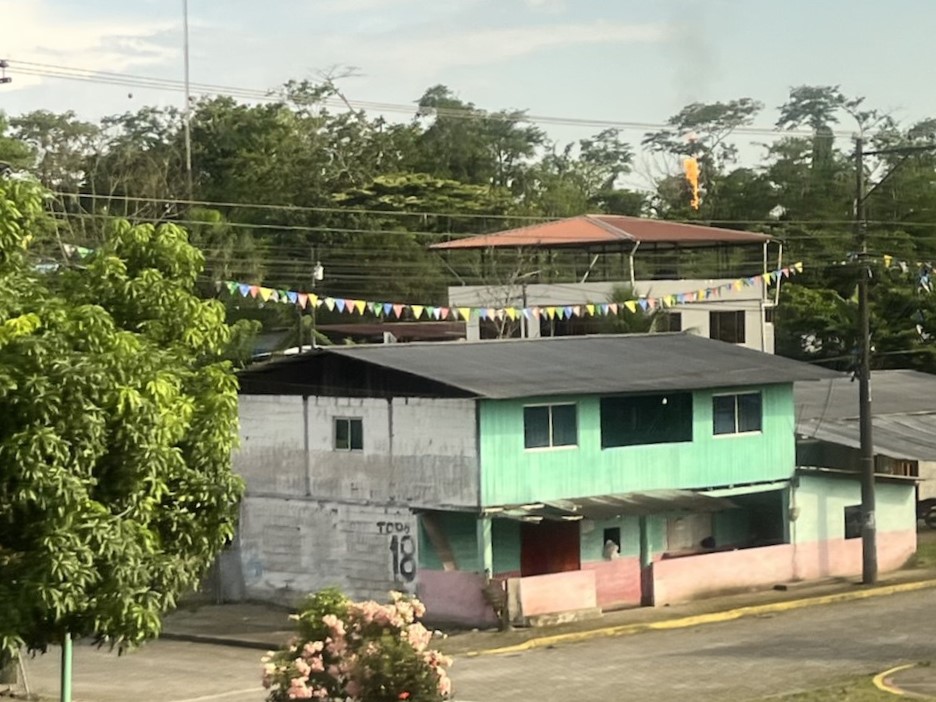
Along the road in the Amazon region, 2025. © Karla García. CC BY-NC-ND 4.0.
by Karla García
The Ecuadorian Amazon region evokes a strange sensation somewhere between awe at the immensity of the rainforest and unease at its intimate coexistence with the oil industry. Upon my arrival, I was amazed by the almost overwhelming green of towering trees, palms, and waterways. But soon after, the highway revealed a different landscape: oil pipelines alongside the road, and gas flares whose vivid flames burned at night and whose smoke drifted during the day. I caught myself looking at the gas flares as if they were a tourist attraction. To the locals, they appear to be just another part of the city, even as some have filed lawsuits to remove them. Some cities in the northeast of Ecuador have developed around the oil industry, so that this infrastructure is part of their landscape. Still, these same cities display enormous sculptures of jaguars, colorful birds, and pink dolphins in their roundabouts and avenues, celebrating the region’s rich biodiversity.

Within this context, local organizations and NGOs are working towards the recovery of Indigenous knowledge and practices, seeking to mitigate the effects of the oil industry and to revive ancestral ways of relating to nature. It is within this tension that I began conducting my research on Rights of Nature’s expertise. My broader research question centers on the way nature’s expertise is shaped at the intersection of ancestral knowledge, plural law, and modernity. It is ultimately tied to how such ecological subjects emerge and the variations in which hybrid perspectives and practices may coexist. During my fieldwork, I connected with a local NGO dedicated to fostering socio-environmental processes through permaculture. Its members, composed mainly of local farmers and Indigenous peoples, seek to restore and repair their territories, sharing the belief that health begins in the soil.
The NGO holds assemblies every few months to provide updates, discuss upcoming projects, and promote the exchange of knowledge and experiences among its members. One weekend, I had the opportunity to join such an assembly. Despite the diverse ethnic, generational, and professional backgrounds of those present, there was a palpable sense of shared love for the jungle’s marvelous nature. Over the course of the weekend, discussions included permaculture improvement, healing therapies for oncology patients affected by oil drilling-related activities, and strategies to promote childhood education. The gathering also included moments of music, dance, and poetry.
Participants shared insights they had gained from some Indigenous practices in the region, including how communities cultivate the land, the plants they use for healing, how they interpret dreams, and more. Dream interpretation, in particular, has become a ritual at the NGO’s assemblies. That Sunday, between four and five in the morning, we gathered in a circle around a large pot of tea. The tea was made from guayusa, a plant traditionally consumed at dawn by Amazonian peoples for its energizing qualities, said to awaken both body and spirit while carrying deep ancestral significance.1 Amid laughter, yawns, dim light, the sounds of insects, and the first birdsong of the day, the gathering reached its peak. Volunteers began recounting their most recent dreams.
I was told that sharing dreams is a well-known practice among local Indigenous communities. Anthropologists working in regions close to the NGO’s location, including Kohn and Mezzenzana, have also encountered these practices.2 Their ethnographies with Runa peoples do not frame dreams as messages to be decoded within the collective but as sources of forest knowledge through which humans (Runas) can relate to other-than-human entities.
In Amazonian Indigenous communities, it is usually elders who interpret dreams, according to one of the NGO’s members. But in the NGO’s assemblies, all participants were welcome to offer interpretations. Occasionally, references were made to the traditional meanings known to the Cofán or Kichwa peoples—for instance, the serpent as a symbol of transformation or warning. Luis, the only Kichwa member among us that day, offered suggestions about some of the elements mentioned, but made it clear that he could not interpret dreams.3 In any case, this practice of dream interpretation within the NGO was not created to dictate someone’s future or prescribe their path, but to provide reflections that might help participants explore and make sense of their own thoughts.
I noticed that the dreams were mostly interpreted as calls to social action. For example, one schoolteacher, newly arrived in a small town, recounted a dream that initially filled him with fear. Snakes recurrently appeared in his dreams, and one had even approached his house in real life. This ominous appearance, along with his town’s struggles, made him consider leaving. Yet through the circle’s reflections and interpretations, the meaning of his dream was reframed. He was encouraged to see himself as a force for change among the children, using his role as teacher to address the alcoholism and social disintegration he had observed. By the end of the session, he spoke with deep conviction about staying and stepping into that role. This moment was especially revealing as it highlighted a lesson often repeated in the circle: problems can be found anywhere, and arriving in a place often means accepting the role one has to play within it.
During my stay I heard many stories of conflict directly and indirectly related to oil and mining activities, such as alcoholism, pollution, or high suicide rates in towns such as Luis’. Despite these struggles, this gathering felt like an “island of hope,” as the members would say, where people supported each other by fostering the change that seemed so urgent and necessary. Here, the NGO’s dream circles, shaped by guayusa dawn rituals, seemed to do more than interpret visions. They were cultivating a particular way of sensing and responding to the territory (territorio, understood as relational land). Dream interpretation went beyond the sharing of fears and desires to become some sort of medium for ethical orientation. Participants understood their dreams as signs of responsibility toward the land, local children, and the wounds left by oil extraction.
Days later, another volunteer from the NGO and I stayed at Luis’ house. He showed us his finca, or farm, where we harvested chonta, the fruit of a local palm widely eaten in the region. That night, we prepared chicha, a traditional fermented drink for the coming local festivities. After long conversations about his community, the NGO, plants, and family, he suggested we engage in dream interpretation with guayusa tea once more.

The next morning Luis lit a fire in a small cabin built from Morete tree trunks and palm leaves, barely three square meters in size. A large pot of guayusa leaves simmered over the flames as we sat on the floor talking about how we had slept and the customs of his village, and laughed about waking up early and struggling to remember our dreams. Luis mentioned that he preferred the way dreams were interpreted at the NGO assemblies to the method of his own community, as at the assemblies, everyone is welcome to participate. By then, I was already reflecting on the intricate entanglement of local, Indigenous, and foreign influences in the revival of ancestral practices within an ecological ethics framework. It was a vivid example of how such practices are not simply adopted, but reintroduced, negotiated, and sometimes contested—not only between locals and outsiders, but also among Indigenous individuals themselves.
Luis shared three dreams that had lingered in his mind, puzzling him. And, soon after, they puzzled me as well. The first dream had come after he had completed a permaculture course at the NGO. He dreamed of standing at the peak of a church. From that height, he could see across the Atlantic Ocean, all the way to Europe.
In the second dream, a person gave him outdoor clothes—possibly a Columbia or Jack Wolfskin rain jacket and pants. He had only seen these clothes on foreigners, as they are not typical of the community, and therefore had never worn them before. This person told him to wear them because he was “ready.”
The third dream occurred after taking a Reiki course, which he had started at the NGO but never finished. This Japanese practice of healing the body through skilled energetic touches seemed to resemble ancestral practices, as Luis’ mother told him they also used to do it, although under different names. In the dream, he was in a traditional Japanese house, fighting with a local, maybe a Reiki expert. Luis told the opponent that he was ready, but he would fight his own way. In all three dreams, a little girl appeared beside him.
Although members of the NGO had previously offered various interpretations, none had truly convinced him. I suggested that maybe the church dream represented his growing sense of ability and perspective regarding the permaculture workshops—that climbing the church symbolized his desire to explore beyond what he knows. The NGO volunteer proposed that the little girl could represent the NGO itself, as he had also seen her in more recent dreams. Luis nodded, though without much conviction, and then said it was time to start the day.

At the NGO, I had been taught that interpreting dreams is collective brainstorming, the offering of ideas or clues that might help the dreamer make sense of what the dream could mean and how to link it back to waking life. Yet neither my input nor the NGO’s suggestions seemed to resonate with Luis. His hesitation was intriguing. Maybe our interpretations were not “mistakes” but “equivocations,” as the anthropologist Marisol De la Cadena would say.4 Drawing on ontological anthropology, she argues that, even when sharing the same event or word, realities can differ without merging completely. Our interpretations came from ethical, pedagogical, or even political-ecological frameworks that were intelligible to us, but they did not fully align with Luis’ perspective. Up to that moment, at least, the external interpretations had not appeared to coalesce for him in the way they had for the teacher, even though he kept asking people for their insights.
I wondered how Luis understood these external interpretations in relation to his daily life, or whether the dreams had anything to do at all with the work he was doing at the NGO. Quietly, he put out the fire, and we went off to prepare breakfast. It seemed that the time to discuss dreams had passed, as he began talking about the rest of the day. For the remainder of my trip, I couldn’t stop thinking about Luis’ dreams and their connection to the NGO’s narrative.
Dream interpretation and other practices I witnessed within the NGO served as instruments for shaping ecological ethics. They are a way of articulating hope, commitment, and an imagination of better futures. In the dawn circles, dreams were not only personal narratives but also mechanisms to orient action. For the school teacher, collective interpretation gave him a sense of duty for the children’s future and commitment to the community. Whereas, for Luis, meanings remained unsettled, pointing to a partial connection between dreams and action. Dream interpretation, as I saw it here, is a space where worlds partially meet, responsibilities are negotiated, and caring for land becomes part of what people understand themselves to be.
- Wilfredo Franco, Alba Margarita Aguinaga Barragán, Diana Astudillo Bravo, Gabriel Picón, Gabriela Loza, Verónica Gallardo, et al., Guayusa (Waysa): Retos y oportunidades para la Amazonía Ecuatoriana (STIGMA, 2018). ↩︎
- See Eduardo Kohn, How Forests Think: Toward an Anthropology Beyond the Human (University of California Press, 2013); Francesca Mezzenzana, “Encountering Supai: An Ecology of Spiritual Perception in the Ecuadorian Amazon,” ETHOS 46, no. 2 (2018): 275–95, https://doi.org/10.1111/etho.12197; Michael Q. Bullerdick, “Dream People of the Amazon: The World View and Dream Life of the Achuar Tribe,” Science of the Spirit, 7 June 2016, https://www.sott.net/article/322632-Dream-people-of-the-Amazon-The-world-view-and-dream-life-of-the-Achuar-tribe. ↩︎
- Luis, whose name has been changed to protect his privacy, was motivated to join the NGO by the work that the team had previously done in his community to prevent suicides. ↩︎
- Marisol De la Cadena, Earth Beings: Ecologies of Practice Across Andean Worlds (Duke University Press, 2015), 212. ↩︎
“Interpreters of Dreams in the Ecuadorian Amazon” © 2026 by Karla García is licensed under CC BY-ND 4.0.
