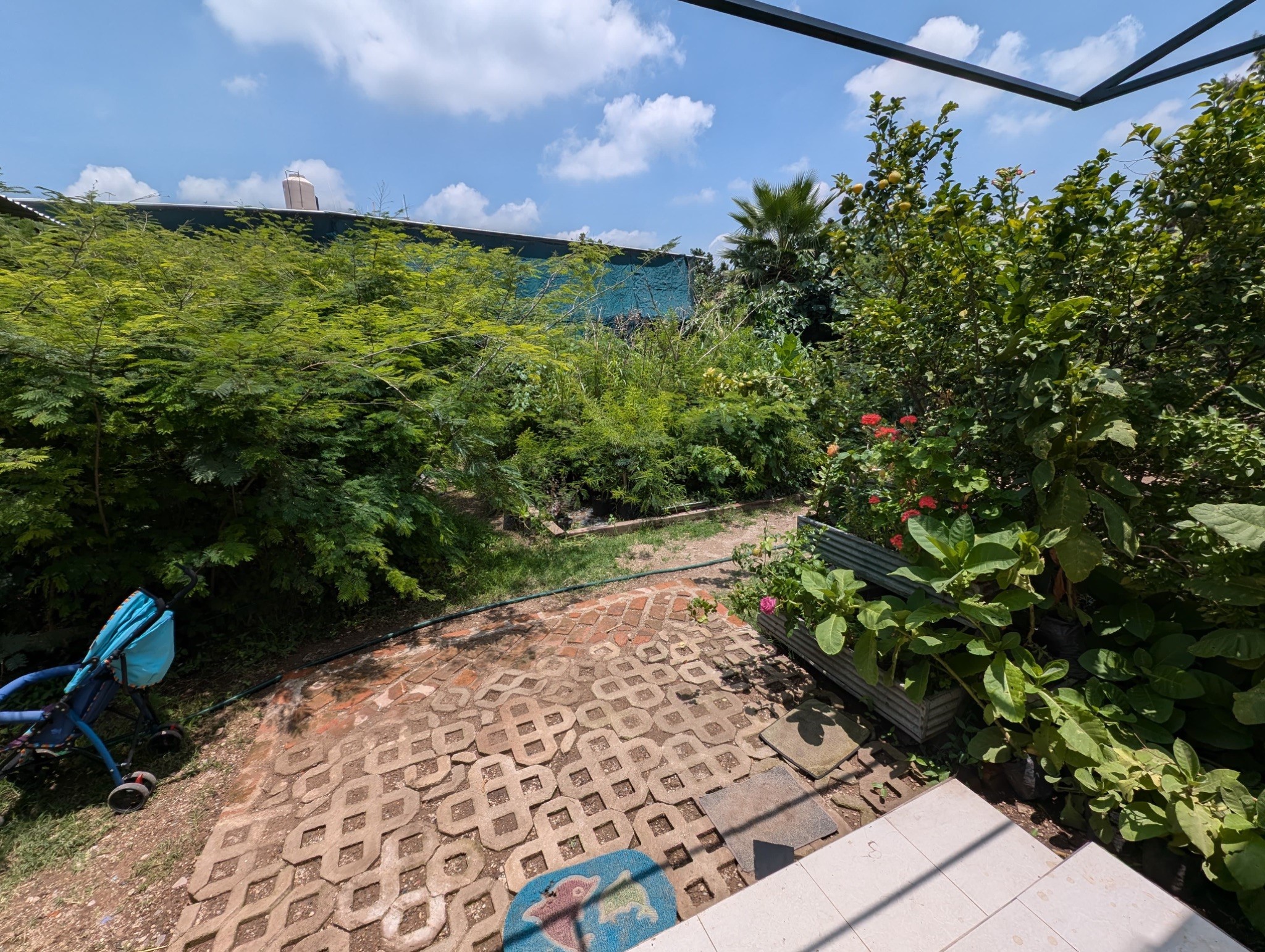
Un Salto de Vida native species garden in El Salto, Mexico. Photo by Carlos E. Sánchez Pimienta. CC BY-NC 2.0
by Carlos E. Sánchez Pimienta
Over the past two decades, there has been growing recognition among health professionals of the profound connection between human health and ecosystems. Historically, health was viewed as a condition of human bodies and minds, but recent crises such as the COVID-19 pandemic and extreme-weather events have prompted health professionals to rethink this perspective. A more holistic approach to health is currently emerging, establishing interdisciplinary frameworks such as that of planetary health, which emphasizes that “humans are part of and not separate from Nature.”1 Furthermore, proponents of planetary health have acknowledged that they have not done enough to engage with Indigenous knowledge systems, which have long recognized and nourished the interconnectedness of human, nonhuman, and environmental health. To address this gap, advocates of planetary health call for meaningful engagement with Indigenous peoples and other historically marginalized communities who have also recognized the interlinked nature of global health.
However, Indigenous scholars have expressed concerns that the contributions of their nations are not adequately represented within planetary-health frameworks. Such misrepresentation is linked to limited awareness of the distinct ontologies (i.e., the fundamental assumptions about reality, being, and knowledge) that underpin Western and Indigenous sciences. In essence, Western and Indigenous sciences make sense when viewed through their corresponding conceptual lenses, but they can be severely misinterpreted when evaluated using different suppositions. Therefore, assessing Indigenous knowledges through the worldviews and values underlying Western science risks perpetuating the misrepresentation of Indigenous knowledges. Yet the health of both people and the planet is more likely to endure if planetary-health practitioners are open to engaging with multiple ontologies, not only with the guiding principles of Western science.
As humans we can envision multiple types of ontologies or “worlds”—two concepts that are used synonymously in some social-science disciplines. Ontology can be considered a theory of reality or possible worlds. In this context, worlds are not pre-existing realities but rather emerge from the daily actions of humans and nonhumans alike. But what kind of a world do most approaches to Western science assume? Philosophers like Bruno Latour contend these approaches embrace three core elements: (1) a linear view of time toward progress, (2) the division between the natural world (i.e., what exists) and various cultural understandings of it (i.e., people’s knowledge of reality), and (3) the separation of modern people and premoderns, those who cannot readily distinguish nature from culture—often inadequately associated with Indigenous peoples.2 In comparison to these ontological assumptions, the ethical commitments of planetary-health frameworks seem progressive, for they call to see humans as a part of nature, unlike assumption (2), and embrace Indigenous knowledges, which had been undervalued due to assumption (3). Others, like West and colleagues, highlight that Western thought is also indebted to paradigms that center on entities or things rather than relationships.3
In contrast to widely held assumptions of the modern Western world, Indigenous writers like Shawn Wilson (Indigenous to the Cree Nation in the land today known as Canada) argue there are multiple worlds or ontologies on earth. In his book Research Is Ceremony, Wilson claims that many Indigenous knowledge systems are grounded in the assumption that reality is fundamentally composed of relationships. In such forms of reality or “worlds” everything is interconnected.4 Assuming a relational ontology can have many implications for daily life, including language. Indeed, many Indigenous languages are verb-based, better accounting for the movement and flow emphasized by relational worlds. Furthermore, many Indigenous languages lack a direct translation for “nature,” which further accentuates the claim that the Western division between nature and culture is not universally assumed.
The idea of multiple ontologies has also been influenced by grassroots movements striving to create alternatives to dominant systems of production, exchange, and consumption. For example, in the state of Chiapas, in southeastern Mexico, the Zapatista Army of National Liberation has popularized the idea of “a world where many worlds fit” (un mundo en el que quepan muchos mundos in Spanish).5 Also known as the Zapatista movement, this multinational Indigenous organization comprises Tzeltal, Tzotzil, Chol, Tojolabal, Zoque, and Mame Indigenous Peoples. Since their movement became public in 1994, the Zapatistas have demanded land ownership, education, self-governance, and health, among other priorities, in the context of systemic racism and oppression by the Mexican nation-state. The Zapatista movement’s work on self-sufficiency in meeting their demands has been renowned internationally as one of the most relevant examples of alternatives to the existing capitalist, colonial, patriarchal, and racial systems. Similarly, the phrase “a world where many worlds fit” encourages any community worldwide to envision and create more just ways of living where everyone’s health can flourish.

Meaningful engagement with the worlds of Indigenous peoples could offer several benefits for fostering planetary health. To begin with, Indigenous knowledge systems have long recognized the holistic interconnections between the health of humans, animals, the land, and water, and all other beings—an understanding that frameworks like planetary health are only beginning to develop. In response to the health impacts of today’s climate crises, scientists and practitioners are increasingly drawing on the knowledge and practices that Indigenous communities use to foster context-based, sustainable, and healthy ways of living.6 Additionally, many Indigenous groups are often at the forefront of land-defense initiatives within some of the planet’s most biodiverse regions. The expertise emerging from such initiatives offers valuable lessons into the strategies and implications of defending local ecosystems from the imposition of major development projects (e.g., clear-cutting, industrial agriculture, large dams, open-pit mining) associated with adverse environmental health impacts. Thus, both traditional and contemporary Indigenous ways of knowing and living have essential insights for tackling contemporary eco-social crises.
Western intellectual circles have seen multiple discussions about climate change, highlighting that the challenges we face in the twenty-first century are not just ecological but also a crisis of imagination. These discussions often focus on scientific and technological solutions, which aligns with the modern assumption that time moves forward in a linear way toward progress. However, some Indigenous thinkers suggest an alternative approach: The current ecological challenges may not be a problem of knowledge or technology, as human communities have historically succeeded in sustaining life for millennia. Instead, the challenges could be seen as a relational issue related to how we treat each other, nonhumans and humans alike. In addressing contemporary eco-social issues as relational problems, Indigenous ethical and legal frameworks may offer crucial guidance in fostering relationships that support a sustained and good life.7
Aiming for more respectful engagement with Indigenous peoples presents planetary-health practitioners with the opportunity to address the historical dismissal, misappropriation, and misrepresentation of Indigenous ways of living and knowing by Western institutions.8 Such dismissal is hardwired into the modern Western world due to its ontological division between moderns (deemed closer to progress) and premoderns (associated with backwardness). In turn, such division creates a hierarchy of knowledge in which premoderns are considered inadequate if they do not align with moderns’ assumptions, values, and priorities. The violence toward non-Western worlds is so severe that sociologist John Law labelled the modern Western world as the “one-world world,” for it automatically dismisses the possibility that the worlds of other groups are equally plausible.9 Instead, the modern ontology renders non-Western worlds as mere cultural beliefs, for it is assumed that Western science has the best grasp of nature or reality. Thus, embracing the possibility of a world of many worlds, as suggested by the Zapatista movement, constitutes an opportunity to acknowledge the contributions of Indigenous worlds without trying to force them to fit into Western assumptions.

With its calls to consider humans as part of nature and embrace Indigenous knowledges, planetary health is a promising approach to rethink health in a time of climate crises. However, it is essential to consider how modern Western assumptions about reality may both enable and constrain our thinking and practice. Facing the existence of multiple ontologies or worlds, the reality assumed by modern Western thought cannot be taken for granted as a universal truth. Instead, by opening up to a multiplicity of worlds, those interested in planetary health may be better able to learn from grassroots Indigenous defense initiatives, gain inspiration from Indigenous relational-ethics frameworks, and do their part in subverting colonial relationships that have historically dismissed Indigenous contributions. Overall, working toward planetary health in “a world where many worlds fit” may expand the range of options to tackle contemporary crises while fostering healthier and more just ways of living.
- The Planetary Health Education Framework (Planetary Health Alliance, 2021), https://doi.org/10.5822/phef2021. ↩︎
- Bruno Latour, We Have Never Been Modern (Harvard University Press, 1993). ↩︎
- Simon West, L. Jamila Haider, Sanna Stålhammar, and Stephen Woroniecki, “A Relational Turn for Sustainability Science? Relational Thinking, Leverage Points and Transformations,” Ecosystems and People, 16, no. 1 (2020): 304–25, https://doi.org/10.1080/26395916.2020.1814417. ↩︎
- Shawn Wilson, Research Is Ceremony: Indigenous Research Methods (Fernwood Publishing, 2008). ↩︎
- “Fourth Declaration of the Lacandon Jungle,” Radio Zapatista (blog), 25 December 2005, https://radiozapatista.org/?p=20287&lang=en. ↩︎
- Robin Wall Kimmerer, Braiding Sweetgrass (Milkweed Editions, 2014). ↩︎
- Nicole Redvers, Anne Poelina, Clinton Schultz, Daniel M. Kobei, Cicilia Githaiga, Marlikka Perdrisat, Donald Prince, and Be’sha Blondin, “Indigenous Natural and First Law in Planetary Health,” Challenges 11, no. 2 (2020): 29, https://doi.org/10.3390/challe11020029. ↩︎
- Linda Tuhiwai Smith, Decolonizing Methodologies: Research and Indigenous Peoples (Zed Books, 2012). ↩︎
- John Law, “What’s Wrong with a One-World World?,” Distinktion: Journal of Social Theory 16, no. 1 (2015):, 126–39, https://doi.org/10.1080/1600910X.2015.1020066. ↩︎
Planetary health has so far been predominantly studied by natural scientists and medical experts. Over the next few months we will publish a series of essays that illuminate different aspects of the planetary-health concept from a decidedly environmental-humanities perspective. The entries have their origin in the contributions of international scholars who attended the Rachel Carson Center workshop “Imagining Planetary Health, Well-Being, and Habitability,” convened by Lijuan Klassen and Christof Mauch and sponsored by the Volkswagen Foundation.
“Fostering the Health of Humans and the Planet in a World of Many Worlds” © 2025 by Carlos E. Sánchez Pimienta is licensed under CC BY-ND 4.0.
