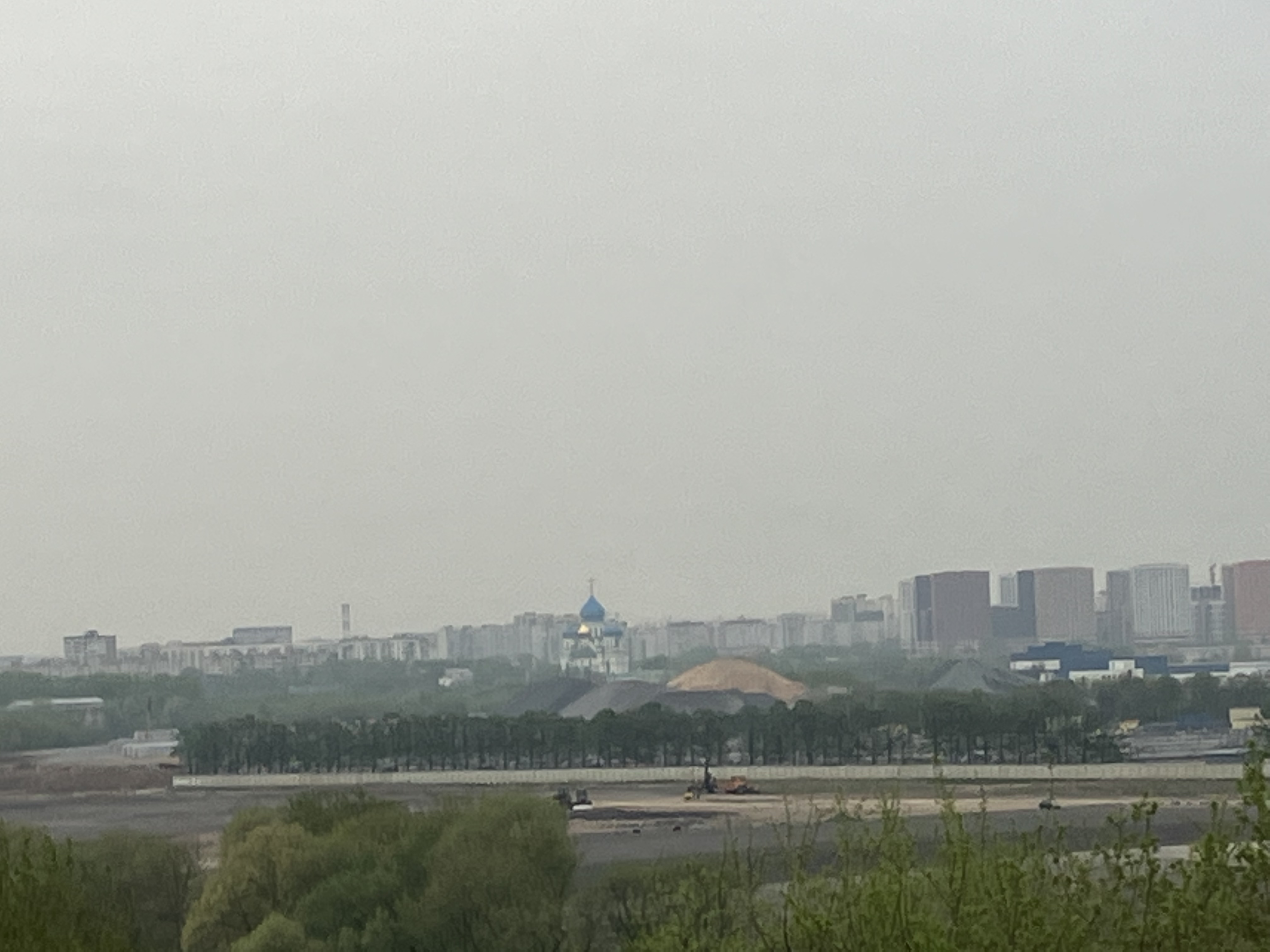
The banks of the Moskva River, Moscow, with the trees cleared out to install air-defense systems. © Anonymous photographer. All rights reserved.
by Vita Lacis
Russian governmental measures at the outset of their invasion of Ukraine loosened numerous environmental regulations to prop up Russian industry and business enterprises. Two years into the war the economy still seems to be going strong. But what are the costs to the environment?
The famous slogan about militarist economies—“guns before butter”—is now the most accurate description of the Russian economic transformation since the start of its brutal invasion of Ukraine. In July 2022, Josep Borrell Fontelles, High Representative of the Union for Foreign Affairs and Security Policy, predicted that sanctions imposed on Russia would soon force Putin “to choose either butter or guns,” thus locking him “in a vice that is gradually tightening.” While the Russian president continues to insist that the country isn’t planning to halt nonmilitary economic production to boost military output (i.e., various machines that bring death and suffering in Ukraine and elsewhere), the viral images of a bakery transformed into a drone-manufacturing plant hint that rather the opposite is the case. Beyond the proverbial butter, the Russian government has found a tangible domain where the impact of international sanctions can be outsourced: the environment.
Cannon Barrels instead of Trees
Pechatniki, Moscow. Where once laid a patch of unruly green overgrowth on the left bank of the Moskva River opposite the Kolomenskoye Museum-Reserve, there is now only bare ground and a fenced construction site after the installation of a new air-defense system. Images of the destroyed forest strip spread across Russian Telegram channels—becoming a symbol of the war coming home to Moscow. Woods and fields that belonged to the UNESCO-protected area were destroyed in the name of state security.
Looking beyond this example, how exactly have Russia’s environmental policies changed since 24 February 2022? To answer this question, we need to not only look at the environmental and climate projects, legislation, and rhetoric of top officials in Russia but also assess how the Russian economy has transformed to a war footing and how changes in environmental policy are embedded in the new course of the state’s domestic and foreign policy.
I should pause here to make a disclaimer: In the grand scheme of history, events such as the Russian invasion of Ukraine are incredibly difficult to assess in the moment. Environmental issues, no matter how significant, are often buried behind news from the front lines, reports of war crimes, and propaganda analysis.
However, despite the lack of attention certain issues may receive, we can distinguish the contours of the changes taking place and asserting themselves in the new reality. Let us put forward a few theses: first, the mobilization of the Russian economy for military needs led to a reduction of funding in other fields, including environmental and climate projects and programs. Second, the Russian state’s decision to start a full-scale war resulted in a massive foreign-capital flight (including green capital), a drastic increase in sanctions pressure, and a demolition of gas revenues. All of these factors have played a significant role in the further reduction of the scope and scale of the available green-transition measures and low-carbon technologies. And finally, environmental activists and nonprofit organizations engaging with the impact of Russian economic activity are being met with an even greater level of state repression than before the war.
Recognizing these theses will help us navigate through the “fog of war.”
The Military Economy Is beyond Suspicion
Two of the most prominent changes to the Russian economy after the invasion of Ukraine have been a significant liberalization—by means of loosening social, technological, and environmental regulations, and—rather paradoxically—the socialization of a considerable part of the economy. These two tendencies culminated in the decree of “partial” martial law in Russia.
Since the beginning of the so-called “special military operation,” the Russian government has been assuring the public that environmental programs and measures will be retained—that the level of environmental protection will not be reduced—as environmental safety is paramount. Nevertheless, just a week after the war had begun and the first set of sanctions had been imposed, the government presented a “plan of priority actions to ensure the development of the Russian economy in the context of external sanctions pressure.” One of the plan’s points was to reduce the number of supervisory measures to control the environmental impact of the state. In particular, a one-year moratorium on scheduled inspections by the Federal Service for Supervision of Natural Resources (Rosprirodnadzor) was introduced, which was subsequently extended until 2030.
In the next six years, planned inspections will only be carried out at high-risk facilities, and unscheduled inspections will only be allowed in particularly severe cases, which include a threat to the life or serious harm to the health of citizens, disaster emergencies, or a threat to the security of the state. Moreover, these inspections must be coordinated with the public prosecutor’s office or conducted on the direct order of the president and the government.
My source in the Russian Social Ecological Union (RSEU) notes that already now “there is a whole range of evidence that Rosprirodnadzor and other supervisory bodies refuse to conduct inspections [on citizens’ complaints] under the pretext that they will not be allowed to conduct these inspections.” This is against Russian law, but wartime brings its adjustments to law enforcement.

According to the Kommersant, a major Russian newspaper, the 2022 moratorium has continued a trend that started in the first year of the COVID-19 pandemic: Russian businesses effectively eliminating the requirement to undergo inspections. While in 2019 there were 1.5 million inspections, in 2022 there were only about 340,000: 238.9 thousand planned and 99.5 thousand unscheduled. So far, it is difficult to judge the negative consequences of this decision in full, but it certainly gives enterprises and businesses more leeway in terms of compliance with environmental and technological standards. This also includes companies that have not fallen under sanctions. Companies unaffected by sanctions benefit from the relaxation of regulatory control as they appeal for the same “special treatment” from the state, referring to the “difficult conditions.”
As my Russian contact reports: “We have specific examples—Nornickel, Rusal1—whose products were still in demand [last year], there were no sanctions on the production and supply of these products. Nevertheless, they too were postponing their plans to reorganize their technologies to reduce the harmful impact on the environment and the health of citizens.”
Free Ride for Cars and Tanks
Among the first, most harmful measures after the start of the invasion was the repeal of requirements for the Russian automobile industry: Since April 2022, cars with engines of all environmental standards, even Euro 0 emission standard (i.e., with no restrictions on the level of emissions), have been authorized for production in the Russian Federation. Due to the suspension of supplies of electronic control units, car manufacturers found that they could no longer assemble cars to the current Euro 5 standard. According to the annual report of the Russian governmental statistics agency, Rosstat, the total production of motor vehicles decreased by 47.4 percent in 2022 compared to 2021, and the output of passenger cars fell by 68 percent. Such a collapse in itself could lead to a reduction in emissions, or at least limit their growth—but just how desirable would such “decarbonization” be, especially when it is accompanied by the exponential growth and impact of the Russian military-industrial complex?

Significant liberalization has also affected the construction sector: In May 2022, a government decree reduced the number of mandatory requirements for construction projects by 93 percent. Of the 69 mandatory requirements, only five remained, and not in their entirety but only in certain departments. At the same time, the State Expert Review Panel put a one-year moratorium on adverse determination for infrastructure projects—only comments were allowed. This meant that even if significant discrepancies were found during the audit, the project would still be approved. Additionally, the procedure for the construction of “priority infrastructure facilities” was simplified, although, after public outcry, restrictions on construction in protected areas (Specially Protected Natural Territories) remained in force.
Among the other changes was an April 2022 governmental decree suspending environmental impact assessments for the construction of military facilities, trunk infrastructure, and garages. And the government did not stop there: initiated by the Ministry of Construction and Deputy Prime Minister Marat Khusnullin in October 2022, the State Duma introduced a bill to extend the suspension of environmental impact assessment until 2025. The changes were proposed to be enshrined at the level of the Urban Planning Code, which has “higher legal force” than a simple decree.
“There is no explanatory note on this bill, so its goals are not clear, but most likely it is about speeding up and simplifying construction under sanctions,” explains a seasoned expert on protected areas in Russia with whom I was able to connect. “This is quite a dangerous thing, because the state expertise and project documentation do not fully assess the environmental side of certain projects, which is particularly important for protected areas. Now there is a plan to build a gas pipeline to Mongolia and China from Siberia [Power of Siberia-2]. According to the plans, it should go through the Tunka National Park—which is illegal—but if they legalize it, then now it will not even have to undergo an environmental impact assessment,” says my source, who was affiliated with Greenpeace before the organization was forced to close its Russian branch. It seems that business enterprises in Russia have been given carte blanche in everything related to environmental legislation.
War on Nature
The Russian invasion of Ukraine has created serious dilemmas for European and US leaders. How could one deter a major nuclear power from waging a war of conquest? Economic sanctions were chosen as one of the major weapons, but they have not managed to dismantle Russia’s industrial-military complex and its ability to wage war. Instead, the Russian government found a way to “outsource” the damage from the war machine to the places and people that were already vulnerable. Russia’s direct military expenditures increased by three times to over one hundred billion US dollars (six percent of the GDP), while its output grew by over 50 percent relative to preinvasion times.

Even before the war, environmental-protection areas as well as Indigenous lands in Russia faced serious pressure from the expansion of mining and industrial enterprises. However, local activists could rely on the letter of law to halt or sometimes even prevent the damage, an option that has now been seriously restricted while public protests are as good as outlawed. This results in situations like the one that happened in Bashkortostan, where an environmental protest against gold mining first led to the imprisonment of the local leader and then to clashes with the police, further repression, and even to the death of one of the activists in custody and the suicide of another one. Of course, this “Cold Civil War” might destabilize Russia in the longer term but so far, the repressive Russian apparatus has a firm grip on dissent, allowing industrialists to continue doing as they please.
At the start of the war, the promises and prognoses of the Russian economy’s imminent collapse were omnipresent—from leading international publications to the IMF. Yet, the Russian economy has sustained the sanctions, and Russia continues to wage war against Ukraine and elsewhere. This has been possible, in part, because Russia has been able to activate the connections and trade routes that link it to other parts of the world where the people in power are all too ready to ignore the invasion.
The mobilized Russian war economy has proven ruthless in its regulatory corner-cutting of “secondary” fields such as environmental protection and technical control. The state now works around the clock producing bullets, ammunition, drones, and tanks, which continue to bring death and destruction to Ukraine, unfretted by any future damage it may cause to the people and nature inside Russia and around the globe.
- Nornickel is a Russian nickel- and palladium-mining and -smelting company, the world’s largest producer of refined nickel. Rusal is the world’s second largest aluminium company, which accounts for around nine percent of the world’s primary aluminium output and nine percent of the world’s alumina production. ↩︎
In the next article: Ahead of the COP28 in Dubai, Russia presented its new climate doctrine. Reading between the lines of this document, the Russian government’s plans in view of a “green” transition are revealed. Read it here.
Read the previous article in this ongoing series here.
“Russian Environmental Politics: Reading Between the Lines—Wartime Ecology: Guns Before Forests” © 2024 by Vita Lacis is licensed under CC BY-ND 4.0.
